Day 1
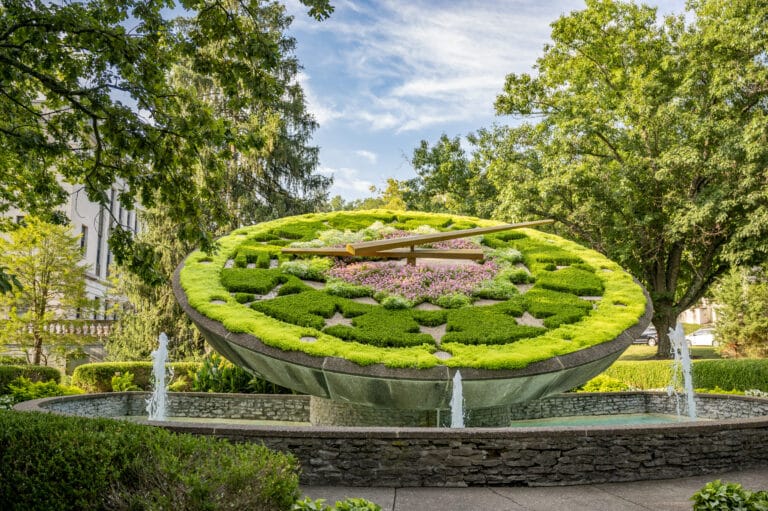
Since you’re in Kentucky’s capital city, you would normally start with a tour of the capitol building with its impressive dome modeled after Les Invalides, the burial place of Napoleon Bonaparte in Paris. However, beginning in June 2025, the Capitol will close for a major renovation lasting from three to five years. You won’t be able to see the House and Senate chambers or the murals depicting Kentucky history, but you will still be able to take a video tour of the building and see select artifacts (portable statues of notable Kentuckians and the doll collection of First Ladies in their inaugural gowns) on display at the Thomas D. Clark Center for Kentucky History. You can also tour the expansive grounds with the iconic Floral Clock whose face is decorated with flowering plants and greenery.
Although not open for tours, the Governor’s Mansion, on the East lawn of the Capitol grounds makes for an impressive photo op. Situated on a bluff overlooking the Kentucky River, the Beaux Arts-style mansion, reminiscent of Marie Antoinette’s residence, Le Petit Trianon at Versailles, has been the official residence of Kentucky governors since 1914.
From the halls of law-making to the corridors of candy-making is a short drive. The Rebecca Ruth Candy Tours & Museum is dedicated to the ingenuity of two Frankfort schoolteachers Rebecca Gooch and Ruth Hanly Booe who gave the world the mouth-watering bourbon ball candy. Learn their story on the informative factory tour and then browse the gift shop and try a free sample.
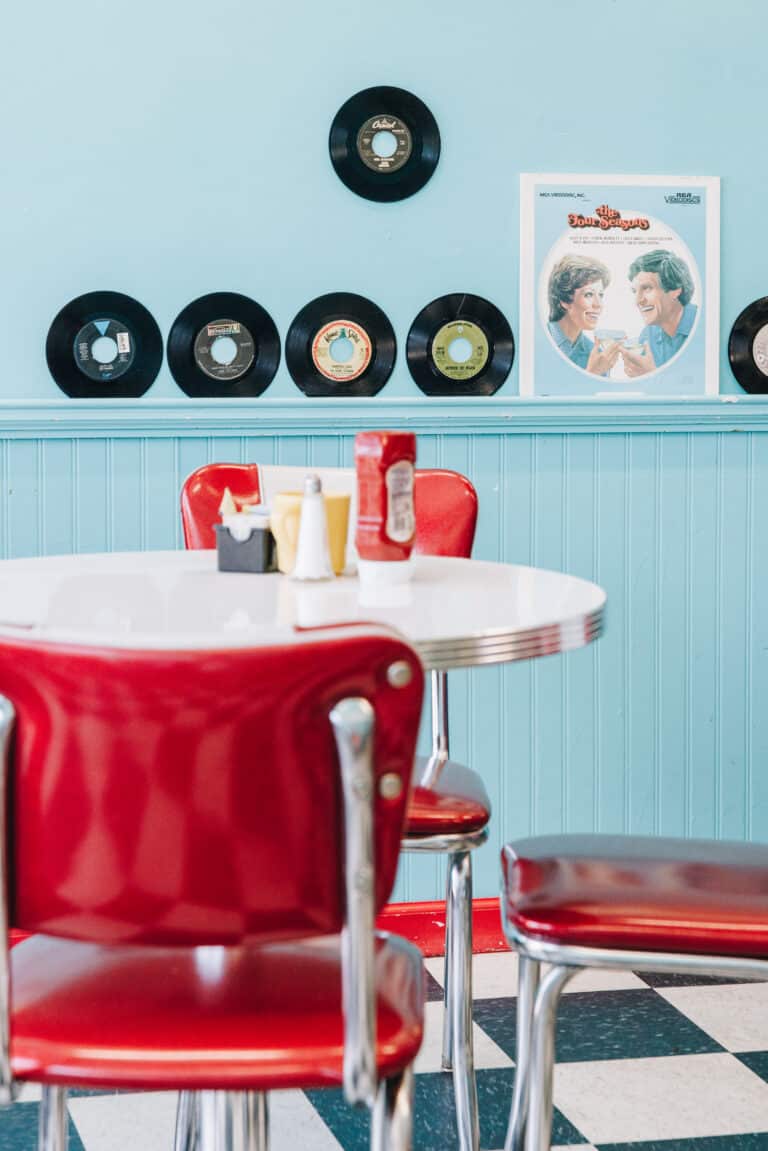
Next, it’s off to the brick streets of historic downtown Frankfort for a look at local shops and art galleries, or a meal at a locally owned restaurant (Main Street Diner for an authentic 1950s vibe or Serafini’s for fine dining with a view of the Old State Capitol).
After lunch, work calories off with a guided tour of the Old State Capitol building, a National Historic Landmark that served as Kentucky’s capitol from 1830 to 1910. The elegance of the Greek Revival building belies a shocking incident that took place here. With his victory still in dispute, William Goebel, the 34th governor of Kentucky, was felled by an assassin’s bullet on January 30, 1900. He was sworn in on his deathbed and died four days later, making him the first governor to be assassinated while in office.
Learn more about Goebel and other famous Kentuckians at the excellent Capital City Museum. Housed in the remains of the Capital Hotel which burned down in 1917, the museum is a quirky collection of Kentuckiana, with exhibits ranging from a replica of the improvised hospital room where Goebel died to a massive Mammoth tooth excavated from Big Bone Lick in northern Kentucky where the huge beasts roamed during the Ice Age. The museum also displays 17 original paintings by artist Paul Sawyier who spent much of his life on the Kentucky River in Frankfort.
The nearby Thomas D. Clark Center for Kentucky History is named after a legendary University of Kentucky history professor and is the headquarters of the Kentucky Historical Society. Here, visitors can trace 12,000 years of the commonwealth’s history through more than 3,000 items in the exhibit “A Kentucky Journey,” and if they have Bluegrass roots, they can trace their family history at the state’s premier genealogical research library.
Those who love military history won’t want to miss the Kentucky Military History Museum, housed in the State Arsenal, dating back to 1850. Perched atop a hill overlooking downtown Frankfort, its Gothic Revival-style architecture gives it the forbidding appearance of a medieval fortress. The building has been the state arsenal for more than a century, and before that, was a Civil War-era munitions factory.
After a busy day of touring, it’s time for some liquid refreshment. Keeping the historical motif going, head to Sig Luscher Brewery, Frankfort’s oldest and America’s eighth oldest brewery. If you would rather have a cocktail, there’s no better spot than the House of Commons Bourbon Library where you can try the city’s eponymous cocktail “The Frankfort.”

Need a place to stay? Whether you prefer modern comforts or a cozy retreat, Frankfort offers a variety of overnight accommodations. Stay in a boutique hotel or a well-known chain for convenience, book a charming bed & breakfast for a more personal touch, or find a unique stay through Airbnb. If you’re looking for an outdoor adventure, nearby campgrounds provide a scenic and peaceful escape. No matter your style, there’s a perfect place to rest before another day of exploring Kentucky’s capital. Check them all out here!
Day 2
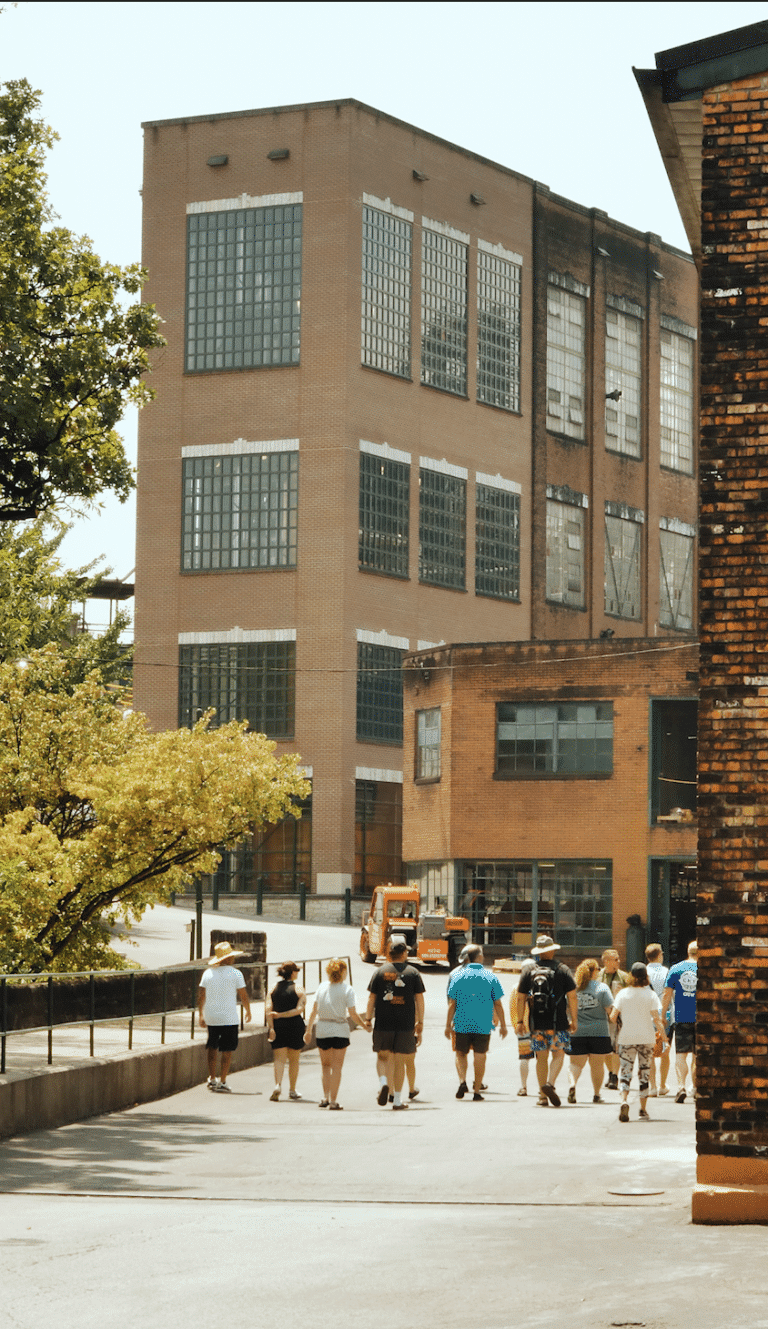
Start the day with bourbon – more specifically, with bourbon at Buffalo Trace Distillery, Kentucky’s oldest continuously operating distillery. Bourbon has been made on these premises overlooking the Kentucky River since the early 1800s. Today, visitors flock here to take one of four complimentary guided tours – from the signature Trace tour to the specialty botanical garden tour. Of course, all tours come with a sampling of Buffalo Trace’s award-winning whiskies. Plan to budget some post-tour time for the well-stocked gift shop.
 If you’re hungry for lunch, head back downtown and get a bite at of of the many local restaurants in the heart of downtown Frankfort.
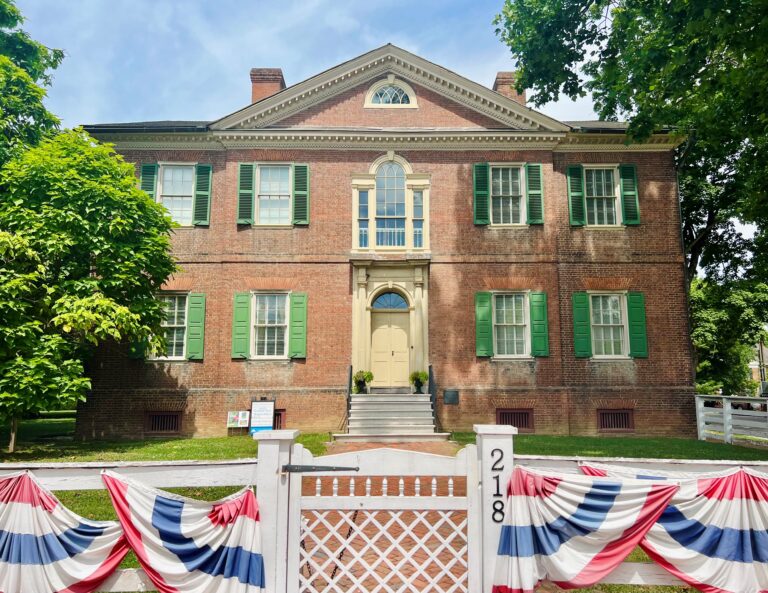
If you need a suggestion for the afternoon, try the tour at Liberty Hall Historic Site. The site consists of two historic homes – Liberty Hall and the Orlando Brown House; one ticket entitles visitors entry to both. Start with Liberty Hall, home of John Brown, Kentucky’s first senator, who started building the house in 1796. On a house tour, you will see the dining room where on one memorable morning, Brown, often referred to as “the Father of Kentucky,” hosted a president (James Monroe); a past president (James Madison) and two future presidents (Andrew Jackson and Zachary Taylor) for breakfast. They used the same fine china and crystal that visitors still see today. If John Brown was key to building a free country (serving under George Washington in the Revolutionary War), his son Orlando was key to preserving it. He used The Commonwealth, a newspaper he published, to advance his views on keeping the Union intact prior to the Civil War. After touring both houses, guests should wander the gardens sloping down to the Kentucky River, which are at their finest in spring when blanketed with bluebells and daffodils. Looking up to a second-floor window at Liberty Hall, they may just spot the Gray Lady, a benevolent ghost who has made herself at home in an upstairs bedroom.
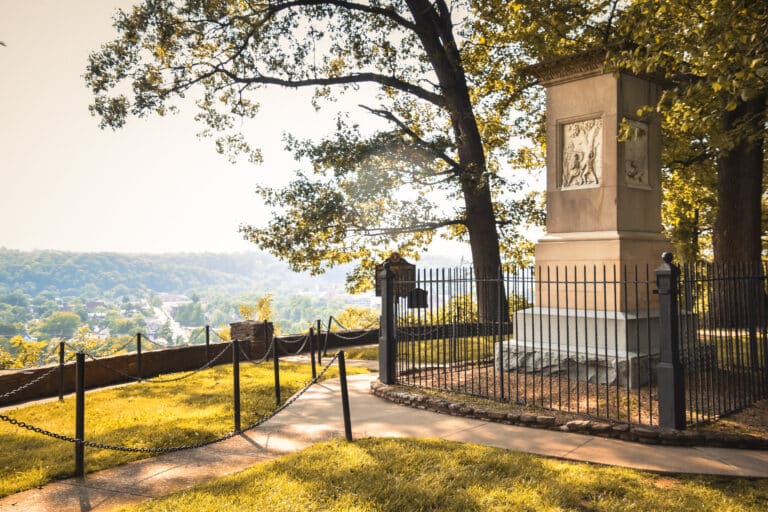
Anyone immersing themselves in Frankfort history should make a point to drive up to the overlook at the Frankfort Cemetery. In addition to getting a spectacular view of the city with the Kentucky River winding through it, they can stop at the grave of Daniel Boone. Maybe. Some feel the final verdict isn’t in as to who really lies in Boone’s grave. There’s proof that his wife Rebecca is buried there, but forensic evidence suggests that the state of Missouri, where the couple were then living, was unwilling to give Dan’l up and substituted another body to be buried. What do you think?
End your day with dinner at the elegant Ashbrook, a 14-room luxury boutique hotel in what was once the home of Buffalo Trace founder E.H. Taylor. Raise a glass of bourbon in his honor in the firelit library before dining in the bistro which pays homage to French country cooking. Beef Bourguignon paired with a glass of Burgundy wine provides a perfect finish to a journey into the history of Kentucky’s capital city.