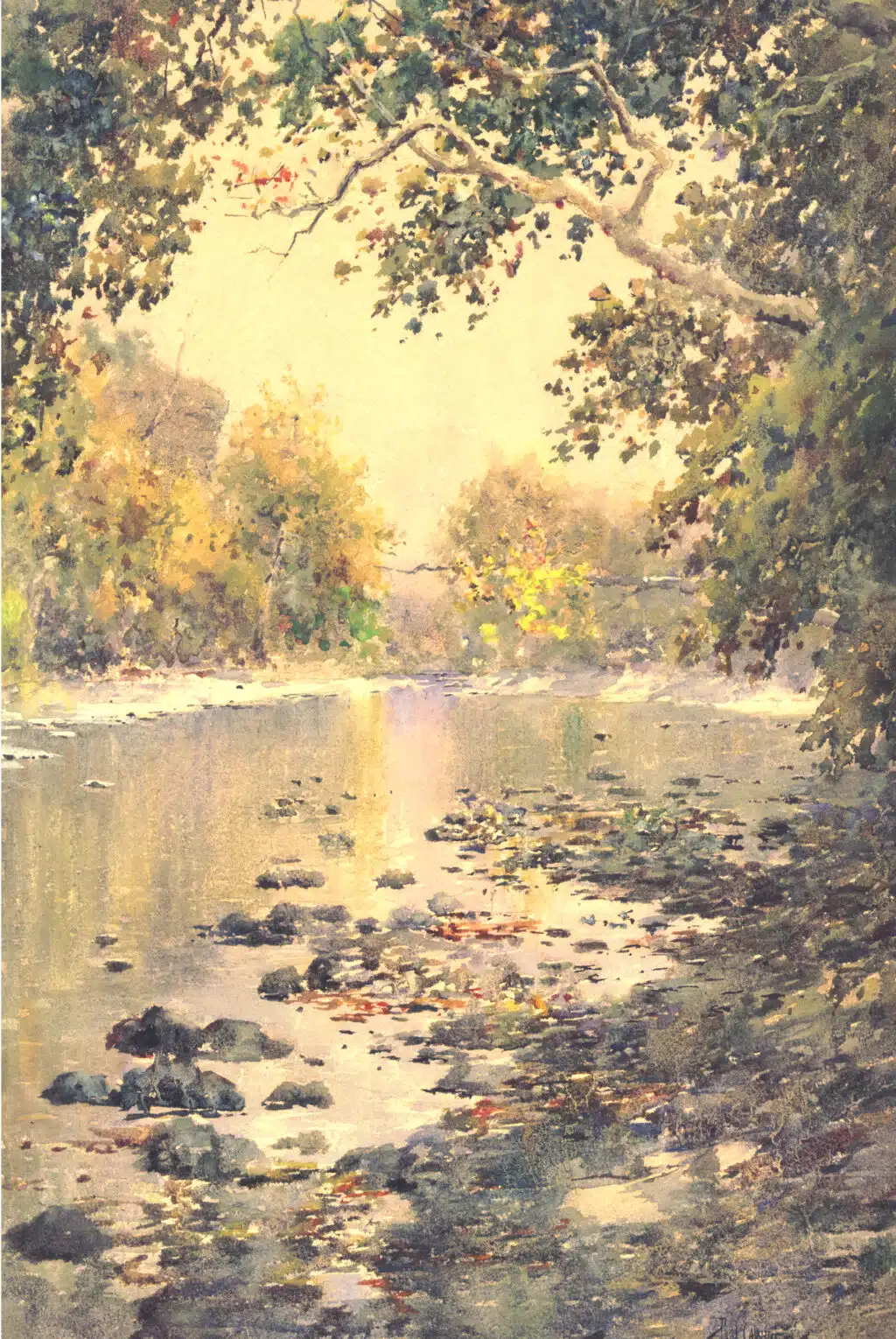
Artist Paul Sawyier is to Kentucky what Georgia O’Keefe is to New Mexico, Grant Wood to the American Mid-West and Clementine Hunter and Mose Tolliver to the Deep South. Arguably the commonwealth’s most famous painter, he became enamored of the Impressionist movement after it was formally introduced in the United States at the 1893 Chicago World’s Fair, and he subsequently became one of the first American Impressionists.
Although born in Ohio in 1865, Sawyier moved with his family to Frankfort at the age of five, and while the last years of his life were spent in New York City and the Catskill Mountains of upstate New York, it was the bucolic Central Kentucky countryside that inspired many of his 3,000 original oils and watercolors, about half of which have been located or accounted for.
If Monet had Giverney and Turner and Constable had the marshlands of England’s East Anglia Region, Sawyier had Frankfort, Elkhorn Creek and especially the Kentucky River as his muses. His passion for Kentucky’s waterways is apparent in such contrasting works as “A View on Dix River,” which is infused with warm yellow tones, and “Elkhorn Reflections,” a study in blues and greens.
One of his river-themed works, “Boys Wading,” painted while he was living on a houseboat on the Kentucky River, is noteworthy in that one of the boys is rumored to be Howard Hughes, who is known to have vacationed as a child on that stretch of Elkhorn Creek.
If Sawyier was infatuated with river life, he was equally enamored of Kentucky’s capital city and the pastoral landscape surrounding it. His cityscapes of Frankfort, including “Rainy Day in Frankfort,” evoke the 19th century street scenes of Paris, a mecca for European Impressionists. In this canvas, the damp chill of a winter afternoon is palpable. By contrast, he is equally adept at capturing the warm autumnal hues of a late fall day on Frankfort’s Wapping Street.
Though early in his career Sawyier emulated the noted portrait painter John Singer Sargent whom he was able to observe while studying in New York, his greatest success came from capturing on canvas the simplicity of rural life in Kentucky – whether it was a harsh winter scene at Camp Nelson or the innocence of a summer twilight illuminated by fireflies as illustrated in the pastel colors of “Sunset at Benson Creek.”
In common with his fellow impressionists, Sawyier used graceful strokes of color to create a nostalgic blur – the world as the artist sees it and not as it really is.
Where to See Paul Sawyier’s Art in Frankfort
The Capital City Museum:
This gem of a museum is known for all things Kentucky, including a second floor gallery in the Russ Hatter Library which features only one original pastel by Sawyier – unusual in that it is a portrait rather than a landscape. However, the current exhibit does showcase the work of two of Sawyier’s female students, Bertha Scott and Jessie Cox Burgess. You can see the influence of their mentor in their lovely landscapes.
The Thomas D. Clark Center for Kentucky History:
Across from the Capital City Museum is the Thomas D. Clark Center for Kentucky History, housing the Kentucky Historical Society. The Center is on the site of what was Sawyier’s boyhood home, and according to registrar Ashley Buzzanca, it has more than 100 works by Sawyier, believed to be the largest collection in the world. The pieces, primarily watercolors, are kept in storage to preserve the delicate colors. However, Buzzanca says there is always one representative piece in the Center’s “A Kentucky Journey” exhibit.
Paul Sawyier Public Library:
Frankfort’s public library has acknowledged Sawyier’s importance to the city by naming the building in his honor. Nine of Sawyier’s works can be seen on the library’s first floor, including seven watercolors, one pastel and one sketch.
Liberty Hall:
A short walk from the Paul Sawyier Library is historic Liberty Hall. The great-grandsons of Liberty Hall’s original owner John Brown were friends with Sawyier and ended up as subjects in many of his works. The Brown family also ended up with some of his paintings – “seven or eight,” according to John Walker, Curator of Collections. Only one, however, can be seen by the public. “The Rose Garden” oil painting hangs in the Kentucky Made Room, and can be viewed on tours of the house.
Despite his prolific output, Sawyier remains relatively unknown to the casual art lover outside of the commonwealth. It is thought he could have become one of America’s most important impressionists had he accepted President William H. Taft’s invitation to show his work at the Corcoran Gallery in Washington, D.C. Inexplicably, he declined the invitation and died in 1917 at the relatively young age of 52.
So, enjoy the work of Kentucky’s own impressionist painter, and who knows……. you might just find some of his pieces in one of the city’s art galleries.